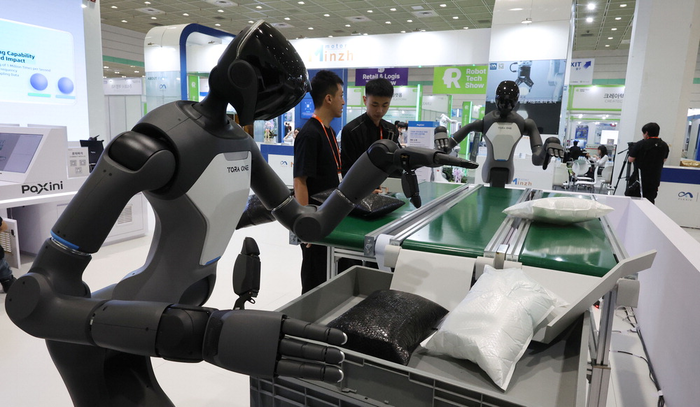
Humanoid robots, artificial intelligence (AI) factories, smart glasses, and AI agents are taking the center stage at the 15th Smart Tech Korea (STK 2026), South Korea’s largest business technology exhibition that kicked off on Wednesday in Seoul.
The three-day event showcases how AI is moving beyond chatbots and digital assistants to become a core technology across manufacturing, logistics, retail, security, and robotics.
The theme for this year’s event – organized and hosted by Maeil Business, MBN and partners – is “The Tech Nexus: A Technology Ecosystem Connecting the Entire Industrial Value Chain.”
For the first time, the exhibition occupies four halls of COEX, making it the largest edition in the event’s history. Organizers aim to attract more than 60,000 visitors, surpassing last year’s record of 52,000.
Seven specialized exhibitions are being held simultaneously – AI & Big Data Show, AI+ Smart Factory Show, RoboTech Show, Digital Distribution & Logistics Fair, SecuTech Show, Smart Tech Show, and Korea Virtual Convergence Industry Expo.
The defining theme of this year’s exhibition is the industrialization of AI.
Rather than focusing solely on generative AI, the event highlights how AI is being deployed in real-world operations across factories, warehouses, and business environments.
When Maeil Business visited the site on Wednesday, the first-floor AI zone featured numerous enterprise AI solutions.
Among them, Clevi Inc., an AI platform company, introduced a database-analysis AI agent designed for enterprise environments.
The platform goes beyond answering questions and can perform actual business tasks autonomously, reflecting growing interest in AI agents capable of executing workflows rather than simply providing information.
Other exhibits showcased Vision-Language Models (VLMs) that monitor safety conditions in hospitals and industrial facilities in real time.
Major technology companies also demonstrated their latest AI offerings.
Samsung SDS Co. showcased industry-specific AI transformation solutions tailored for manufacturing, retail, and service industries.
Dell Technologies Inc. presented “Dell AI Factory with Nvidia,” an end-to-end infrastructure platform developed jointly with Nvidia Corp.
The solution covers the entire AI lifecycle, from model testing and development to deployment in commercial operations.
The robotics hall proved to be one of the event’s biggest crowd-pullers.
Global humanoid robot companies such as AgiBot and Galbot demonstrated their latest technologies.
Several emerging Chinese robotics firms also attracted attention, including PaXini, which displayed robotic hands capable of replicating human touch, and EngineAI, which showed highly agile robotic systems.
Linkerbot also demonstrated advanced robotic hand movements and manipulation capabilities.
A major new addition this year is the AI Factory Expo.
The exhibition features companies developing autonomous manufacturing systems, data-driven factory operations, technologies enabling dark factories, or fully automated factories operating without human workers.
Naver Cloud played a central role by organizing business-matching programs between AI suppliers and manufacturing companies seeking AI adoption.
Strong demand from manufacturers has already resulted in many consultation sessions being fully booked.
A special quantum technology pavilion showcased developments in quantum computing and related applications.
Participants included Amazon Web Services Inc. (AWS), Quantum Intelligence Corp., and ID Quantique SA. Exhibits covered are quantum computing hardware, drug discovery applications, cybersecurity technologies, and educational infrastructure.
Meanwhile, throughout the exhibition, visitors can attend conferences and seminars covering AI, robotics, quantum technology, and smart manufacturing.
The 6th Korea AI Industry Awards will also be presented on Thursday.
Kim Dae-key, Park Sung-bae daekey1@mk.co.kr, park.seongbae@mk.co.kr






Humanoid robots, artificial intelligence (AI) factories, smart glasses, and AI agents are taking the center stage at the 15th Smart Tech Korea (STK 2026), South Korea’s largest business technology exhibition that kicked off on Wednesday in Seoul.
The three-day event showcases how AI is moving beyond chatbots and digital assistants to become a core technology across manufacturing, logistics, retail, security, and robotics.
The theme for this year’s event – organized and hosted by Maeil Business, MBN and partners – is “The Tech Nexus: A Technology Ecosystem Connecting the Entire Industrial Value Chain.”
For the first time, the exhibition occupies four halls of COEX, making it the largest edition in the event’s history. Organizers aim to attract more than 60,000 visitors, surpassing last year’s record of 52,000.
Seven specialized exhibitions are being held simultaneously – AI & Big Data Show, AI+ Smart Factory Show, RoboTech Show, Digital Distribution & Logistics Fair, SecuTech Show, Smart Tech Show, and Korea Virtual Convergence Industry Expo.
The defining theme of this year’s exhibition is the industrialization of AI.
Rather than focusing solely on generative AI, the event highlights how AI is being deployed in real-world operations across factories, warehouses, and business environments.
When Maeil Business visited the site on Wednesday, the first-floor AI zone featured numerous enterprise AI solutions.
Among them, Clevi Inc., an AI platform company, introduced a database-analysis AI agent designed for enterprise environments.
The platform goes beyond answering questions and can perform actual business tasks autonomously, reflecting growing interest in AI agents capable of executing workflows rather than simply providing information.
Other exhibits showcased Vision-Language Models (VLMs) that monitor safety conditions in hospitals and industrial facilities in real time.
Major technology companies also demonstrated their latest AI offerings.
Samsung SDS Co. showcased industry-specific AI transformation solutions tailored for manufacturing, retail, and service industries.
Dell Technologies Inc. presented “Dell AI Factory with Nvidia,” an end-to-end infrastructure platform developed jointly with Nvidia Corp.
The solution covers the entire AI lifecycle, from model testing and development to deployment in commercial operations.
The robotics hall proved to be one of the event’s biggest crowd-pullers.
Global humanoid robot companies such as AgiBot and Galbot demonstrated their latest technologies.
Several emerging Chinese robotics firms also attracted attention, including PaXini, which displayed robotic hands capable of replicating human touch, and EngineAI, which showed highly agile robotic systems.
Linkerbot also demonstrated advanced robotic hand movements and manipulation capabilities.
A major new addition this year is the AI Factory Expo.
The exhibition features companies developing autonomous manufacturing systems, data-driven factory operations, technologies enabling dark factories, or fully automated factories operating without human workers.
Naver Cloud played a central role by organizing business-matching programs between AI suppliers and manufacturing companies seeking AI adoption.
Strong demand from manufacturers has already resulted in many consultation sessions being fully booked.
A special quantum technology pavilion showcased developments in quantum computing and related applications.
Participants included Amazon Web Services Inc. (AWS), Quantum Intelligence Corp., and ID Quantique SA. Exhibits covered are quantum computing hardware, drug discovery applications, cybersecurity technologies, and educational infrastructure.
Meanwhile, throughout the exhibition, visitors can attend conferences and seminars covering AI, robotics, quantum technology, and smart manufacturing.
The 6th Korea AI Industry Awards will also be presented on Thursday.
Kim Dae-key, Park Sung-bae daekey1@mk.co.kr, park.seongbae@mk.co.kr